
July 21, 2026
How Trainers Are Using AI to Retain Clients Longer (2026 Data)
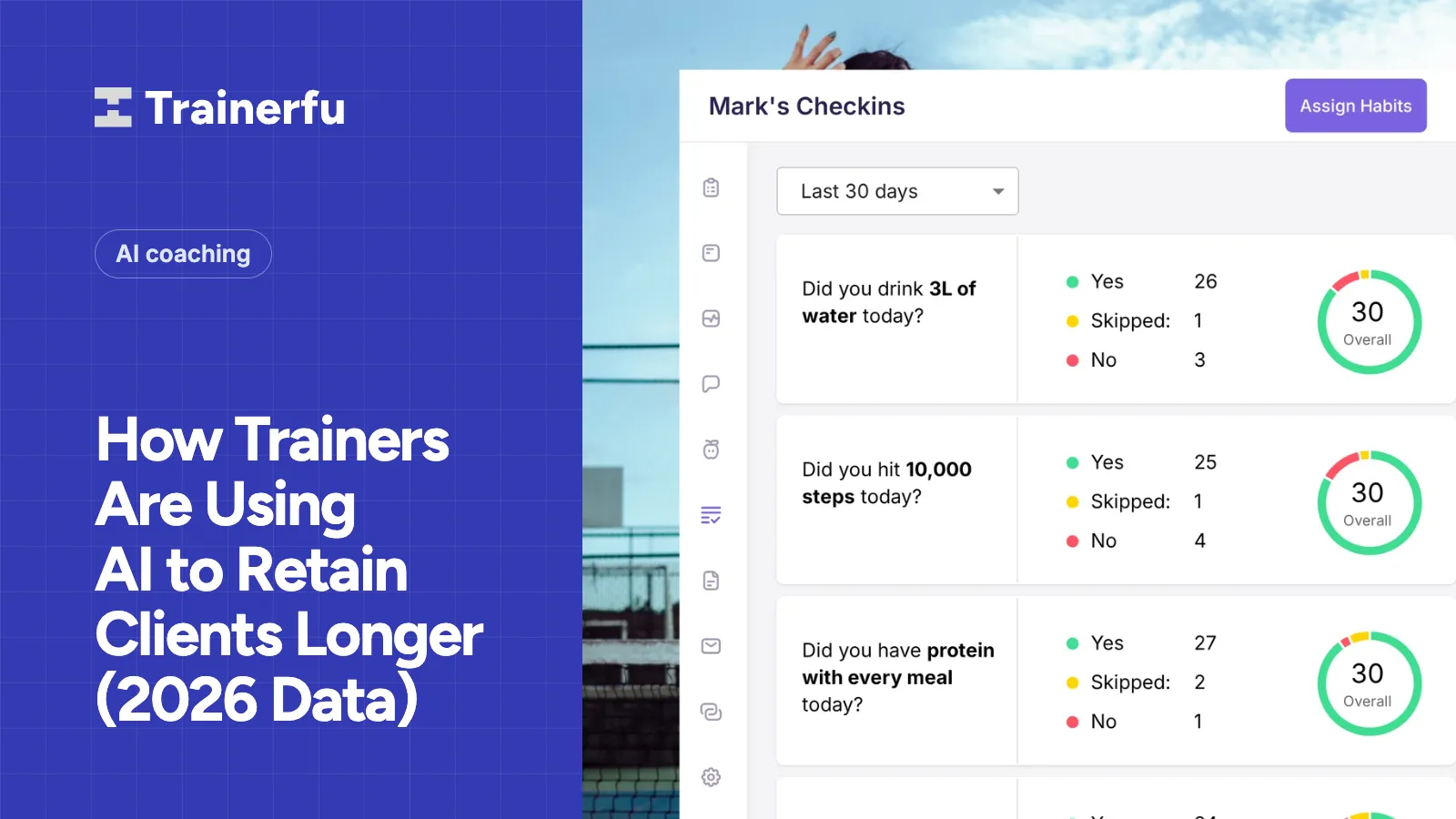
The Quiet Reason Clients Leave Personal Trainers
Ask a trainer why a client cancelled and the explanation usually sounds reasonable.
Work became busy. Family commitments took over. The client went on holiday. Their motivation dropped. Money became tight.
All of those things happen. But they do not fully explain why one client pauses for a difficult month and then returns, while another quietly disappears.
The difference is often what happened before life became difficult.
Did the trainer notice the client had stopped logging workouts? Did the programme adjust when their schedule changed? Did anyone follow up after the second missed session? Could the client see that they were still making progress?
Client retention rarely collapses because of one dramatic failure. It usually declines through small gaps in attention that build over several weeks.
This is where AI fitness coaching can help. Not by replacing the trainer, but by helping the trainer notice patterns, respond sooner, and maintain a more consistent coaching experience across a growing client roster.
The honest part is that AI does not automatically improve retention. Poorly configured automation can feel generic, intrusive, or irrelevant. The value comes from using AI to support the parts of coaching that trainers struggle to deliver consistently at scale.
What the 2026 Data Actually Shows
There is not yet strong independent evidence proving that every trainer who adopts AI will improve client retention by a fixed percentage.
Any company promising a guaranteed 20%, 30%, or 50% retention increase should be asked where that number came from.
What the available research does show is that several mechanisms supported by AI are associated with stronger adherence and engagement.
A systematic review covering 99 digital health studies identified four recurring factors that positively influenced adherence: personalised content, individualised reminders, stable and user-friendly technology, and human support alongside the digital intervention. The average app adherence rate across the included studies was 56%, which also shows that software alone is not enough.
A separate review of just-in-time health interventions found that feedback was more useful when it was personalised, continuously available, goal-oriented, or actionable.
The American College of Sports Medicine also ranked wearable technology as the leading fitness trend for 2026, based on a survey of approximately 2,000 clinicians, researchers, and exercise professionals. That matters because more trainers now have access to ongoing activity, recovery, heart rate, and workout data that can be used to guide client conversations.
The data does not say, “Install AI and clients will stay.”
It says that personalisation, timely reminders, progress feedback, human support, and responsive programming matter. AI gives trainers a practical way to deliver those things more consistently.
For a wider explanation of the category, read Trainerfu’s complete guide to AI fitness coaching for trainers.
Why Client Retention Breaks Down
Most trainers do not lose clients because they lack exercise knowledge.
They lose clients because the coaching experience becomes inconsistent as the business grows.
The Trainer Notices Disengagement Too Late
A client rarely cancels immediately after their first missed workout.
The pattern usually develops gradually:
- Workout completion becomes less consistent
- Check-in responses become shorter
- Logging stops for several days
- Progress photos are delayed
- Questions become less frequent
- The client starts apologising instead of participating
A trainer with eight clients may notice these changes quickly. A trainer with 30 or 40 clients can easily miss them.
By the time the client receives a personal follow-up, they may have already decided that the programme is no longer working for them.
The Programme Stops Matching Real Life
A workout plan may have been personalised when it was created, but that does not mean it remains personalised three months later.
The client’s work schedule changes. Their available equipment changes. They sleep badly for two weeks. A knee issue appears. They travel. Their goals shift from fat loss to strength.
When the programme does not respond, the client begins to feel that they are failing the plan.
In reality, the plan may be failing the client.
The Coaching Relationship Goes Quiet Between Sessions
A client who trains with a coach once or twice a week still has several days when they are making decisions alone.
Those are the days when workouts are skipped, meals become inconsistent, and small setbacks start to feel permanent.
When there is no communication between scheduled sessions, the coaching relationship becomes something the client experiences for one hour rather than something supporting them throughout the week.
Progress Becomes Hard to See
Fitness progress is rarely smooth.
Body weight fluctuates. Strength increases unevenly. Visible changes can take months. A client may feel stuck even while their workout consistency, movement quality, energy, and training capacity are improving.
Without clear progress feedback, clients can conclude that the coaching is not working before enough time has passed for the result they want.
Six Ways Trainers Are Using AI to Retain Clients Longer
1. Detecting Early Signs of Disengagement
The most useful retention intervention happens before the client says they are thinking about leaving.
AI coaching systems can help organise engagement data across a full roster and highlight clients whose behaviour has changed.
That may include:
- A reduction in completed sessions
- Several missed check-ins
- A sudden drop in workout logging
- Lower training volume
- Repeated programme modifications
- A longer gap between app visits
None of these signals proves that a client is about to cancel. They give the trainer a reason to look more closely.
The trainer still needs to decide what the situation means.
A client may be injured, travelling, overwhelmed at work, or simply forgetting to log. AI can surface the pattern, but the trainer provides the judgement and the conversation.
A useful follow-up is not, “The system says you are disengaged.”
It is, “I noticed training has been harder to fit in over the past two weeks. What has changed, and how can we adjust the plan?”
That conversation is where retention happens.
2. Sending Timely Automated Messages
Automated messages are often criticised for feeling impersonal.
Bad automated messages deserve that criticism.
A generic motivational quote sent every Monday does not make a client feel supported. A well-timed message connected to something the client actually did can feel very different.
Trainers are creating automated messages for moments such as:
- A missed workout
- A completed training week
- A new personal record
- A seven-day logging gap
- The end of a training block
- An upcoming progress review
- A client’s first month in the programme
The purpose is not to automate the entire relationship. It is to prevent routine but useful touchpoints from being forgotten.
Research into digital health adherence supports the use of individualised reminders alongside human support. The human support part matters. Automation should create more opportunities for meaningful coaching, not give the trainer a reason to stop communicating personally.
3. Updating Programmes Before They Become Stale
A personalised workout plan should change as the client changes.
AI can reduce the time required to review performance data, identify patterns, and prepare possible programme adjustments.
For example, the system may help the trainer notice that:
- A client has exceeded the target repetitions for three sessions
- The same exercise has caused discomfort twice
- Training volume has declined during a stressful period
- A client is consistently completing only two of four scheduled workouts
- Progress has stalled across several weeks
The trainer can then decide whether to increase load, reduce volume, change exercise selection, or rebuild the weekly structure.
Some tools also allow trainers to create workouts from text. The trainer can describe the client’s goal, equipment, experience, limitations, and schedule, then review the proposed programme before assigning it.
The speed is useful, but speed should not be confused with quality.
AI-generated programming still needs professional review. The trainer understands the client’s movement quality, communication style, injury history, confidence, and personal circumstances in a way that a short prompt may not capture.
For a closer look at the evidence and limitations, see Do AI Workout Plans Really Work?.
4. Making Progress Easier to Understand
Clients do not only need progress. They need to recognise that progress is happening.
AI can help organise months of client data into patterns that are easier for both the trainer and client to understand.
Instead of looking at one weigh-in or one difficult workout, the trainer can discuss:
- Workout completion over 12 weeks
- Strength changes across a training block
- Improvements in consistency
- Changes in resting heart rate
- Increases in weekly activity
- Personal records
- Better recovery between sessions
This matters because a client may be making progress in several areas while focusing only on the one metric that has temporarily stalled.
A good progress review connects the data to the client’s original goal.
“You have only lost one pound this month” feels discouraging.
“You trained 10 times, increased your squat by 15 pounds, and completed your first uninterrupted four-week block” gives the client a more accurate picture.
AI helps prepare the information. The trainer gives it meaning.
5. Personalising the Coaching Experience at Scale
Personalisation becomes harder as a trainer takes on more clients.
Without a reliable system, small client details become scattered across notes, messages, spreadsheets, and memory.
AI can help trainers use existing client information when preparing check-ins, programme updates, or progress conversations.
That does not mean every message needs to be generated from scratch.
It means the trainer can more easily account for details such as:
- The client’s preferred training days
- Available equipment
- Previous injuries
- Exercise preferences
- Current goals
- Recent missed sessions
- Upcoming travel
- Progress milestones
McKinsey’s wellness research found that nearly one in five US consumers and one in three US millennials preferred personalised products and services. It also reported interest in using biometric information to receive more personalised recommendations.
For personal trainers, the lesson is simple. Clients increasingly expect the programme to respond to their data and circumstances.
The trainer does not need to rebuild everything every week. But the client should be able to see that the coaching is paying attention.
6. Creating New Reasons for Long-Term Clients to Stay
Retention does not always mean keeping a client in the same one-to-one package forever.
A client may no longer need weekly coaching but still want structure, community, accountability, or a new challenge.
Trainers can use recovered administrative time to create:
- A six-week strength challenge
- A mobility programme
- A travel workout plan
- A small-group coaching offer
- A maintenance membership
- A beginner training course
- A programme for former one-to-one clients
The trainer can create a landing page for the offer, explain who it is for, and give existing clients a next step that costs less than private coaching but keeps them connected to the business.
This is often a better retention strategy than trying to keep every client in the highest-priced service indefinitely.
The goal is not to prevent clients from changing. It is to give them a relevant option when their needs change.
What AI Should Not Be Used For
AI fitness coaching has real limits.
It Should Not Diagnose Injuries
Workout data cannot replace clinical assessment.
If a client reports pain, neurological symptoms, breathing problems, dizziness, or a possible injury, the trainer should work within their scope and refer the client to an appropriate healthcare professional.
It Should Not Make Unreviewed Programme Decisions
A suggested exercise change may look reasonable while missing an important detail from the client’s history.
The trainer should review meaningful programme changes before they reach the client.
It Should Not Replace Difficult Conversations
A client who is struggling with motivation, finances, confidence, or life stress may need an actual conversation.
Sending more automated reminders is not always the answer.
Sometimes retention improves because the trainer reduces the programme, pauses a goal, changes the service, or admits that the current approach is not working.
It Should Not Turn Coaching Into Surveillance
More client data does not mean every behaviour needs to be tracked or questioned.
Trainers should be clear about what information is collected, how it is used, and what clients can control.
The point is to support the client, not make them feel watched.
A Four-Week Retention Setup for Personal Trainers
Trying to automate the entire coaching business in one weekend usually creates a complicated system that nobody maintains.
A smaller rollout is more practical.
Week One: Map the Client Dropout Pattern
Review the last 10 to 20 clients who cancelled.
Record:
- How long they stayed
- When engagement started declining
- Whether missed sessions were followed up
- When the programme was last updated
- Whether progress was reviewed
- What reason the client gave for leaving
Look for repeated gaps rather than individual excuses.
Week Two: Improve Between-Session Communication
Choose three messages that would make the biggest difference.
A sensible starting point may include:
- A missed-workout follow-up
- A weekly progress question
- A milestone recognition message
Keep the wording natural. Avoid pretending that a scheduled message was written personally in that moment.
Week Three: Review Programme Relevance
Select five long-term clients.
Ask:
- Does the current plan match their schedule?
- Has it changed as their ability improved?
- Are they still working towards the same goal?
- Are they completing the prescribed number of sessions?
- Has the programme become repetitive?
Update the plans that no longer fit.
Week Four: Build a Simple Retention Dashboard
Track a small number of useful indicators:
- Average client length
- Monthly cancellations
- Workout completion
- Check-in completion
- Number of inactive clients
- Programme review dates
Do not collect data simply because the platform makes it available.
Track information that leads to a coaching action.
Trainerfu has also published a separate guide on how AI fitness coaching can reduce weekly administrative work, which can help identify where retention work fits into the trainer’s schedule.
Measuring the Revenue Impact of Better Retention
Retention calculations do not need to be complicated.
Start with:
Average client value = Monthly coaching fee × Average number of months retained
A client paying $150 per month who stays for eight months is worth $1,200 in coaching revenue.
If the average client stays for 10 months, the value becomes $1,500.
Across 30 clients, that two-month difference represents $9,000 in additional cohort revenue before considering referrals or upgrades.
This is an illustrative calculation, not a guaranteed outcome from adopting AI.
The purpose is to show why small retention improvements can matter. A trainer does not always need more leads. Sometimes the bigger opportunity is helping current clients stay engaged for longer.
Transparency note: This guide is published by Trainerfu, an AI coaching platform for personal trainers. We have held AI coaching tools to the same standard we would apply to any other fitness technology.
Final Thoughts
Here is the thing fitness software companies sometimes avoid saying: AI will not repair a weak coaching relationship.
It cannot make a trainer care. It cannot replace good judgement. It cannot turn irrelevant programming into a service clients want to keep paying for.
What it can do is make consistency easier.
It can help trainers notice declining engagement before cancellation. It can support timely communication. It can make programme updates faster. It can organise progress data. It can help a trainer maintain a personalised workout plan across a larger roster.
Those are not small improvements.
They address the quiet operational gaps that cause good clients to drift away from otherwise capable trainers.
The best way to judge whether this works for your business is not to upload your entire client roster immediately. Bring one real client into Trainerfu’s 14-day free trial, with no credit card required, and use it for two weeks.
See whether you notice problems sooner, communicate more consistently, and spend less time managing routine work.
That is more useful than any promised retention percentage.
Frequently Asked Questions
How does AI fitness coaching improve client retention?
AI fitness coaching can support retention by identifying declining engagement, sending timely reminders, organising progress data, and helping trainers update programmes sooner. It works best when these systems support regular human coaching rather than replace it.
Can automated messages make coaching feel impersonal?
They can when the messages are generic, excessive, or unrelated to client behaviour. Automated messages are more useful when they arrive at a relevant moment and lead to a genuine trainer response when the client needs support.
Which client retention metric should personal trainers track?
Start with average client retention length. Trainers should also monitor monthly cancellations, workout completion, check-in participation, and the number of clients who have become inactive.
How quickly can AI improve client retention?
There is no independently verified timeline that applies to every coaching business. Trainers may notice earlier engagement signals within weeks, but meaningful retention changes usually require several months of consistent use and measurement.
Can AI create a personalised workout plan for every client?
AI can help produce a starting plan based on information supplied by the trainer, but the trainer should review the programme before assigning it. Client history, movement quality, injuries, confidence, and changing circumstances still require professional judgement.
Similar articles
AI coaching
AI Workout Periodization: How Smart Software Programs Progressive Overload
AI workout periodization explained: how smart coaching software programs progressive overload, manages training phases, and adapts automatically so clients keep making progress in 2026.
Read article
AI coaching
AI Coaching Software for Online Trainers: The 2026 Guide
An honest guide to AI coaching software for online trainers in 2026, covering what the AI actually does, what to look for, and how to choose without the hype.
Read article
AI coaching
5 Best FitSW Alternatives for Personal Trainers
An honest look at the best FitSW alternatives in 2026, covering AI features, client management, and which platform fits your coaching business.
Read article